
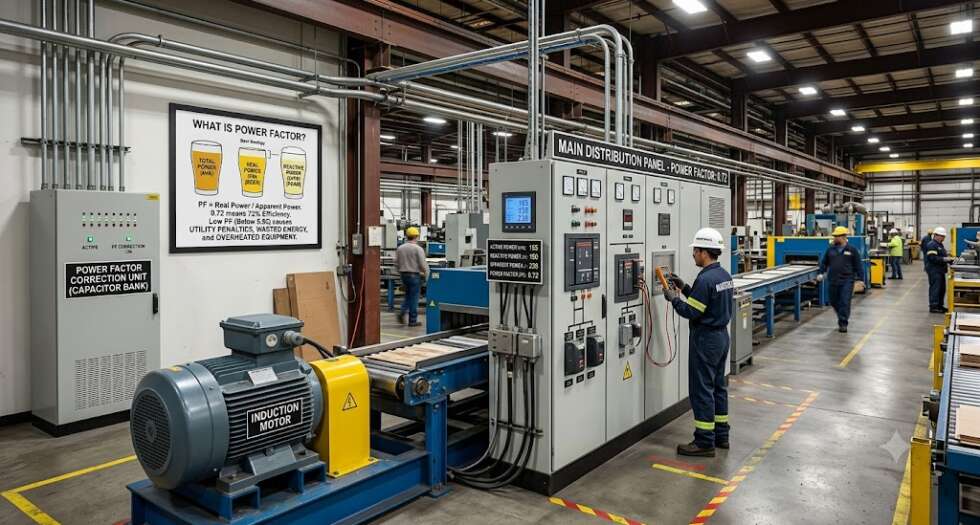
If you’re in manufacturing, that line item could be costing you thousands of dollars every month for energy you aren’t even using.
Here is the simplest way to understand Power Factor (PF)—without needing an electrical engineering degree:
Think of power factor like a glass of beer. 🍺
- Real Power (kW): This is the liquid beer. It does the actual work—spinning your motors, running conveyor belts, and powering your air compressors.
- Reactive Power (kVAR): This is the foam on top. It doesn’t do “work,” but it’s necessary to create the magnetic fields that dynamic equipment (like induction motors and transformers) need to operate.
- Apparent Power (kVA): This is the entire glass—the total energy the utility company has to deliver to supply both the beer and the foam.
Power Factor (PF) is simply the ratio of Real Power to Apparent Power (Liquid ÷ Total Glass).
- 👉 1.0 (or 100%) means a glass full of pure liquid—zero waste.
- 👉 0.85 (or 85%) means 15% of the power capacity coming into your facility is spent maintaining fields, not pushing output.
Why should manufacturing leadership care?
- Utility Penalties: Most utility companies charge heavy penalties if your PF drops below a threshold (usually 0.85 to 0.95). You are paying for the whole glass, even if a quarter of it is foam.
- Lost Line Capacity: Low power factor causes higher current draw. That extra current heats up your transformers, trips breakers, and limits how much new machinery you can add to existing electrical infrastructure.
- Shortened Equipment Lifespan: Excess current creates unnecessary thermal stress on internal distribution components, leading to premature equipment failures.
What can operations teams do about it?
- Audit heavy loads: Run energy audits on oversized, under-loaded induction motors (which have notoriously low power factors)
- Install Capacitor Banks or Active Harmonic Filters: These supply reactive power locally at the load, taking the burden off the grid and bringing your PF close to 1.0.
- Consider Variable Frequency Drives (VFDs): VFDs can improve the displacement power factor of motors while optimizing speed control.
Fixing your Power Factor is often one of the highest-ROI energy projects in a manufacturing facility—frequently offering payback periods of under 12 to 18 months.
Does your facility monitor Power Factor in real-time, or do you only check it when the monthly utility bill arrives?
#ManufacturingOperations #EnergyEfficiency #PlantEngineering #MaintenanceAndReliability #IndustrialAutomation
